
noomiclone

noomiclone
noomiclone Is One Decision, Repeated Until It Lands
The whole of noomiclone is one act: letting go of a high bar and hoping the body arrives at the next one. It is a browser physics game about a ragdoll gymnast, and it reduces a round to a swing, a release and a fall. You pick the moment. Then you watch a body you no longer control travel toward the bar. Catch and the counter at the top of the screen adds one regrab; miss and the attempt ends on the red floor.
That shape is why the game belongs on a site built around 2v2 io. A duo match is a run of fast decisions with a restart waiting at the end, and noomiclone removes the match and keeps only the decision. There is no lobby, no opponent and nobody on the other side to read. What you read is your own swing: how much momentum the bar has stored and how little time is left before the release stops being useful. For a player who queues the next round before the last one ends, that is a familiar rhythm with the noise taken out.
Ten seconds is enough to learn the four keys. Trusting your release takes considerably longer, and the players who quit early are usually the ones treating it as a reflex rather than a decision.
Play noomiclone Online Free, With Nothing to Install
The build in the player above is a Unity WebGL export that streams into the tab, so there is no installer, no account and no launcher between you and the bar. Click once, let the bundle load, and the white posts, the red floor and the sagging black ragdoll appear.
Free and unblocked mean the same narrow thing here as everywhere on this site: no install, no login and no purchase. Neither word promises that a school or office filter will let the domain through, because those systems decide by address rather than by game, and no filter asks what the page contains.
The four commands also exist as large buttons in the corners of the frame, labelled arch, tuck, let go and reset. A mouse alone is enough to play, which matters more than it sounds: the browser build never asks for a keyboard at any point.
noomiclone Controls: Four Keys and the Only One You Time
- 1
Arch with the left arrow
Holds the body open while you swing. Arching is the shape you hang in between moves and the shape you leave the bar with, so it works more like a resting state you interrupt than a move you fire. (Left arrow)
- 2
Tuck with the spacebar
Pulls the body compact. In the air this tightens the rotation, and tightening the rotation is the only way to bring the gymnast around faster before the next bar arrives. (Space)
- 3
Let go with the up arrow
Releases the bar. This is the decision the game is built on: too early and the flight is short, too late and the body sails past the bar it was aiming for. (Up arrow)
- 4
Reset with R
Returns to the opening of the same scene. Nothing is deducted and nothing is saved, so a failed attempt reads as a rehearsal rather than a loss. (R)
The Release Decision, and Why Shape Beats Timing at First
Momentum on the bar is free. You swing and it builds whether or not you are paying attention, so the interesting question is never how to get speed. It is what to do with the speed you already have.
The developer describes the physics from the other end: momentum and rotation carry through every move, so no two attempts finish the same way. Read that as a design statement rather than a difficulty setting. The bar hands you a fixed amount of energy, the release picks the direction, and the tuck decides how fast the body turns on the way there. Three variables, and only two of them can still be changed once you are airborne.
The counter at the top of the frame is the only score the web build reports, and it counts regrabs rather than attempts. That single number says what the game considers success: not a landing, not a pretty pose, but hands back on a bar. Reading the score as a regrab counter instead of a trick counter makes practice honest, because the elegant pose that ends in a fall scores nothing here.
My own reading is that the tuck is the friendlier variable to experiment with. Timing a release to the frame is a skill that arrives slowly, while the shape you hold in the air changes the result immediately and visibly. Feedback you can see is what eventually teaches the timing, and the reset makes that loop cheap.
noomiclone Screenshots: A Hang, an Arch and a Mid-Air Roll
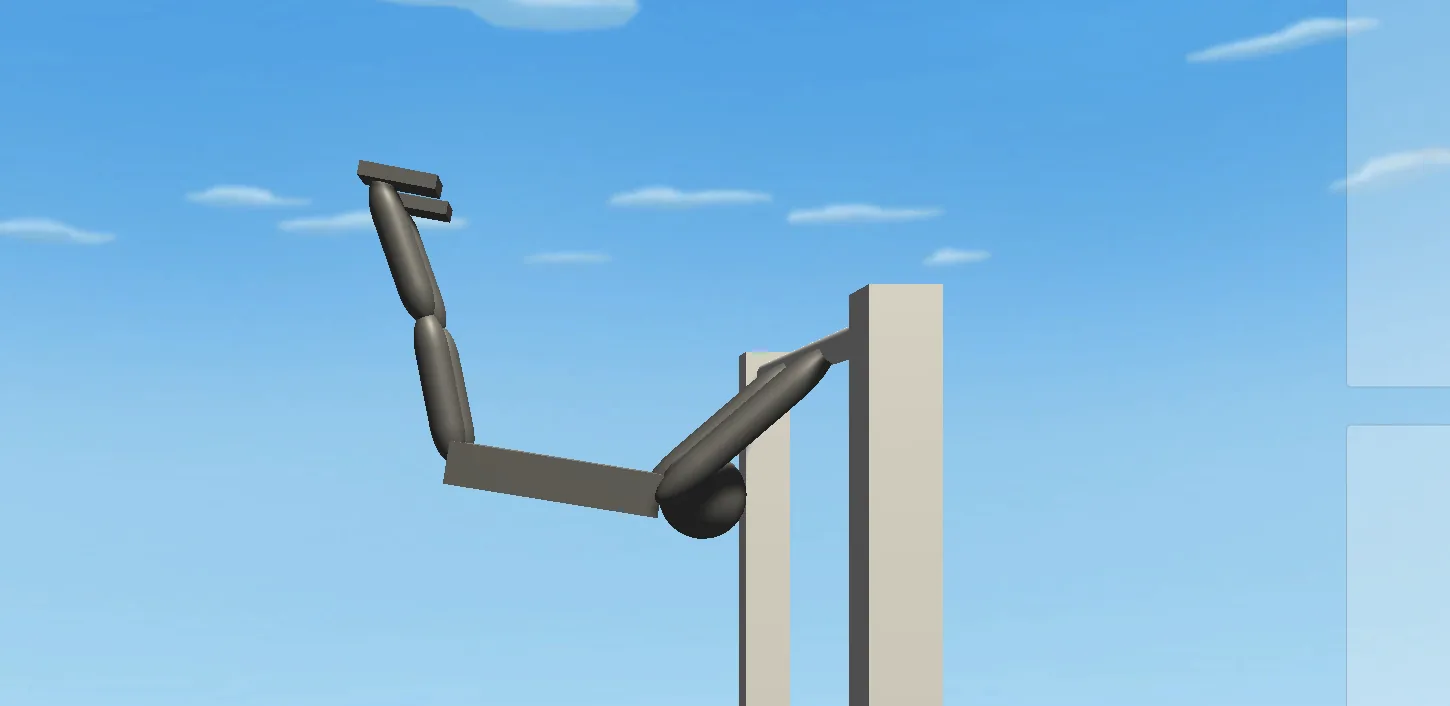
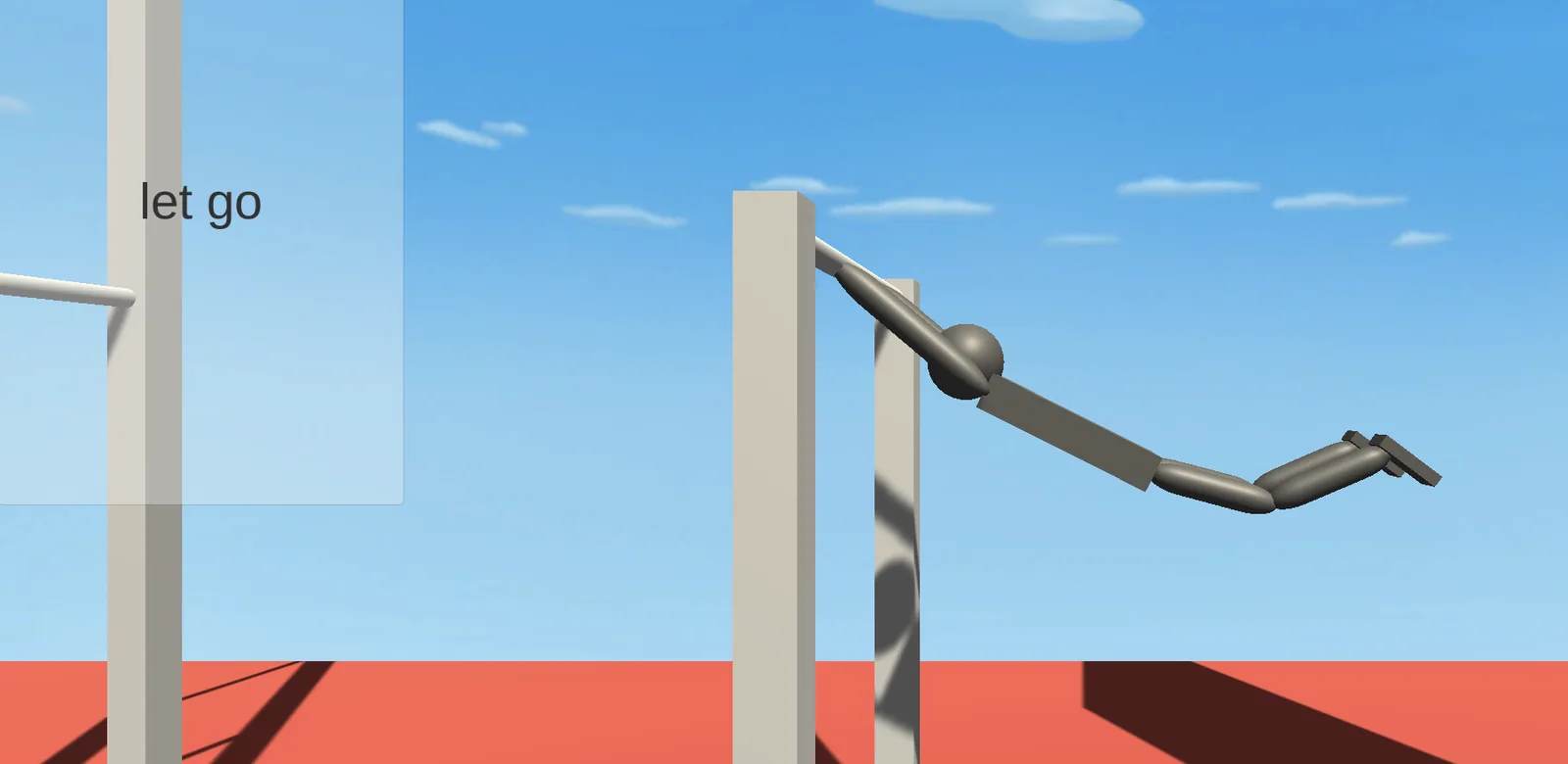
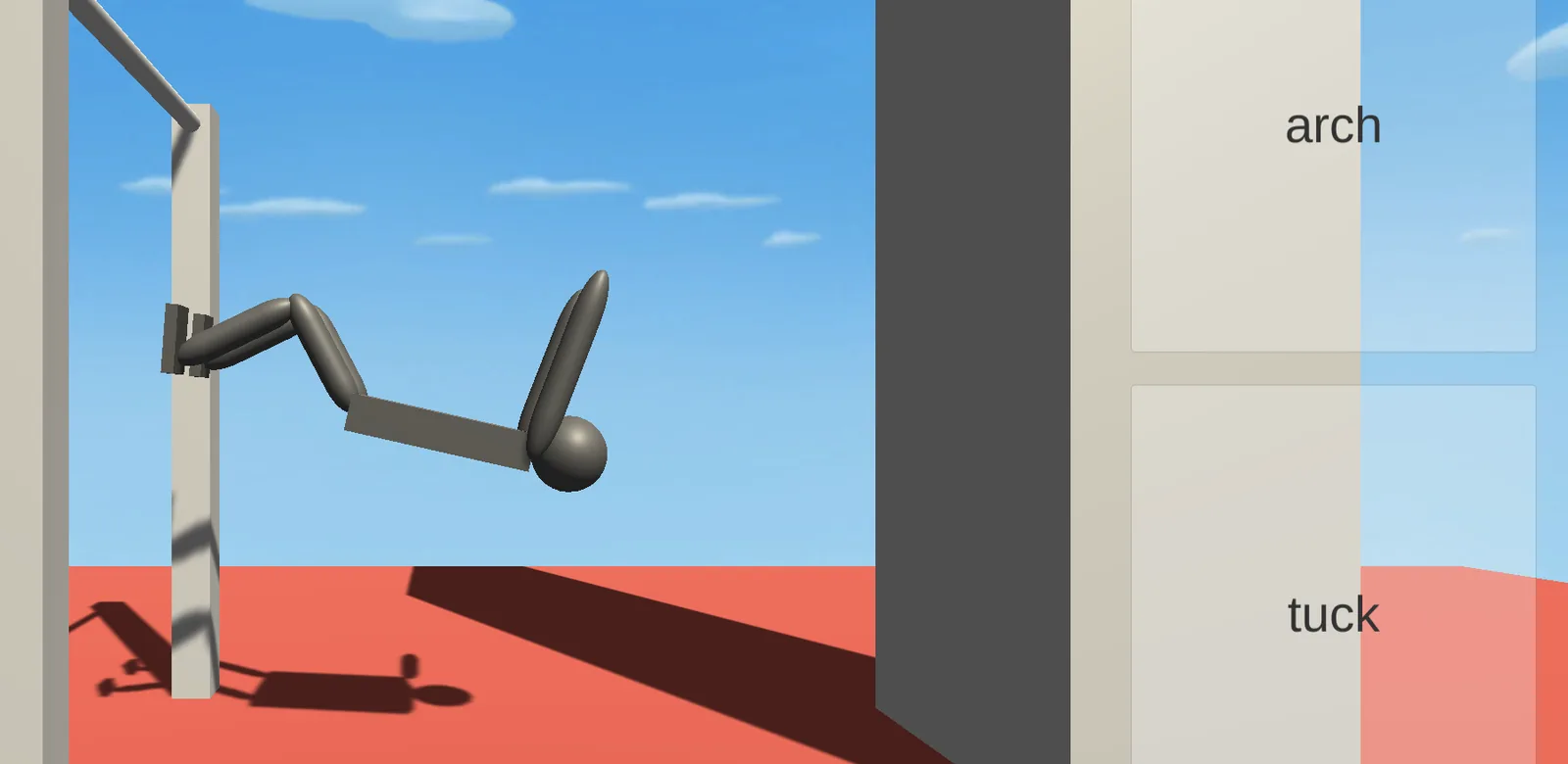
One Scene, Four Buttons: What the Browser Build Leaves Out
Search for noomiclone maps and nearly every result describes the phone app. The browser build has one scene, no map picker and no mode menu, and the developer's itch page still labels it In development while the mobile release sits at version 2.3.2. Two products share a name, a designer and a physics engine, not a feature list.
The gap is specific enough to state plainly. Google Play lists twelve bar maps and six tumbling maps for the app, eighteen in total, along with moves such as Pike, Layout, Twist, Flash Kick and Stuck Landing. The browser build exposes four actions and no way to change stage, and the extra moves have no control attached to them there. Anyone who reads a move list and then opens this page will go looking for keys that do not exist.
Slow motion, replay export, draggable on-screen buttons and the high frame rate option are documented for the mobile release only, as of the last store listing. Nothing in the browser build suggests they are on their way, and the version stamp of 0.9 does not argue with that reading. Anything promising slow motion or replay here is describing the app.
For this site the honest framing is that the web build is a demonstration of one idea, and the idea is strong enough to stand on its own. Promising a tumbling course here would be a promise the page cannot keep.
What an Instant Reset Does to the Way You Practise
R restarts the scene from the top with no penalty, so a bad attempt costs the two seconds it takes to swing again. That changes the arithmetic of practice in a way a match-based game cannot: you can spend an entire session on one release height and take thirty attempts at it.
The failure mode is the opposite of the obvious one. Because the reset is free, the temptation is to abandon an attempt the moment it looks wrong, and a player who bails at the first wobble never learns where the release actually failed. The 2v2 io instinct of leaving a losing round early is the wrong instinct on a high bar.
A rule worth borrowing from games with lives: decide before the swing what you are testing, then let the attempt finish even when it is clearly short. Watching a bad flight all the way to the floor is how you measure how far off the release was, and that measurement is the entire return on the attempt.
Ten minutes of that beats an hour of restarting.
Games Like noomiclone, for Players Who Reset Without Thinking
The other games on this site share one habit with noomiclone: a short attempt, an instant restart, and a score that only moves when a decision goes right. The closest loops are listed below.


noomiclone FAQ: Controls, Maps and the Web Build
Is noomiclone free to play?
Yes. The browser build opens in a tab with no purchase and no account. The mobile app is free too and carries ads plus in-app purchases, mostly for skins.
Do I need to download noomiclone?
No. It is a Unity WebGL build that loads in the browser, and the developer distributes it as a web page rather than a file.
What are the noomiclone controls?
Left arrow arches, spacebar tucks, up arrow lets go of the bar, and R resets the scene. The same four actions are also drawn as buttons in the corners of the frame, so a mouse can play without a keyboard.
How many maps does the browser version have?
One. The scene has no map picker. The twelve bar maps and six tumbling maps belong to the mobile app, and mixing the two lists is the most common mistake in write-ups about this game.
Is noomiclone the same game as NoomiClone?
Yes. NoomiClone is the spelling on the app stores and the itch page; noomiclone is the name this site lists it under. One game, two spellings.
Does noomiclone work on a phone?
The browser build draws touch-sized buttons for arch, tuck, let go and reset, and native iOS and Android versions exist. Touchscreen feel was not measured for this page, so treat the buttons as present rather than rated.
Is there a noomiclone leaderboard or world record?
No official leaderboard appears in any of the developer's listings. The counter at the top of the browser build tracks regrabs on your own machine, so any record is personal.
Who made noomiclone?
The stores credit Matthew Jones, with NoomiClone Dev as the Google Play developer name and jamesnorth on itch, and the Unity build carries the company name JamesWest. No official page says how those names connect.