
Noillirk

Noillirk
Noillirk Is a Crowd-Reading Game, and the Bet Is Your First Answer
Noillirk hands you ten prompts a day, thirty seconds each, and no options to choose from. The answer comes out of your own head: name a European capital, name a bowling term, name a film by a particular director. The game then places your answer on a board the makers wrote in advance, ranked by how likely a hundred people would be to say it, and pays you for the rank.
That inversion is what turns a quiz into a decision. Being correct is nearly free here; being ordinary is the skill. A sharp answer nobody else would give lands off the board for ten points, while the obvious name at the top pays a hundred. You are not competing with the person who knows more than you. You are competing with the average reflex of a stranger you will never meet.
For a reader who comes to this site for 2v2 io, that is the same muscle in slow motion. You are reading an opponent you cannot see, and the opponent is what most people would blurt out. The difference is tempo, because nobody is rushing you but the clock. So the thirty seconds get spent arguing with yourself.
Play Noillirk Free, One Daily at a Time
Nothing installs and no account is created. The game is the front page of noillirk.com, it runs in a browser with JavaScript on, and it can be added to a phone's home screen and opened as its own window. Progress, streak, nickname and sound settings sit in the browser's local storage.
The Daily is shared and numbered. Everyone opening it on the same date gets the same ten prompts, the set rolls over at local midnight, and the run is labelled with an edition number. The rules page dates the first one to 15 October 2026, and the domain was registered the same day, which makes that date stronger than any directory listing.
Free is literal here as well. There is no paid tier and no subscription, and nothing on the page sells an account upgrade. The terms describe it as an independent game rather than a product with a payment system behind it.
Noillirk Controls: Type, Enter, Pass, Repeat
The entire control surface is a text box. Type an answer and press Enter, or click the arrow beside the field; on a phone the keyboard's Go key does the same job.
There are no arrow-key bindings and no movement layer. That is worth stating plainly, because most browser games of this shape have one.
Pass skips the prompt for zero points and asks for confirmation before it does, so the button is not a trap. A click on the scene, or the Tap to skip control, cuts the reveal short once you have seen your band and your points.
How Noillirk Scoring Rewards the Boring Answer
Every accepted answer falls into one of five bands. The board's top answer pays 100 points, second and third pay 75, fourth and fifth 50, sixth through tenth 25, and anything accepted but unranked pays 10.
Prompts get heavier as the run goes on. Questions 1 and 2 count once, 3 to 5 count twice, 6 to 8 three times, and 9 and 10 four times. A runner-up answer is worth 75 early and 300 on the last prompt, so the same quality of guess is worth four times as much depending on when it lands.
Do the arithmetic on the final two prompts and the strategy stops being subtle. Two top answers there pay 800 points, which is more than the first four prompts can pay even if all four are perfect, since those only add up to 600. A safe name late beats a clever name early by a margin that no amount of knowledge closes.
The score then becomes a headcount. One of the hundred spectators walks over for every 25 points, rounded down, and stays for the rest of the run. A perfect Daily pays 2,500 and pulls all hundred, which is why the end screen reads as a crowd rather than a total.
One thing worth knowing before you read that crowd as public opinion: the board is an estimate made in advance, not a live tally of what players typed today, and the result cards label it as an estimate for that reason. You are guessing a model of people, not people.
Noillirk Screenshots: A Pass Dialog and a Timed-Out Prompt
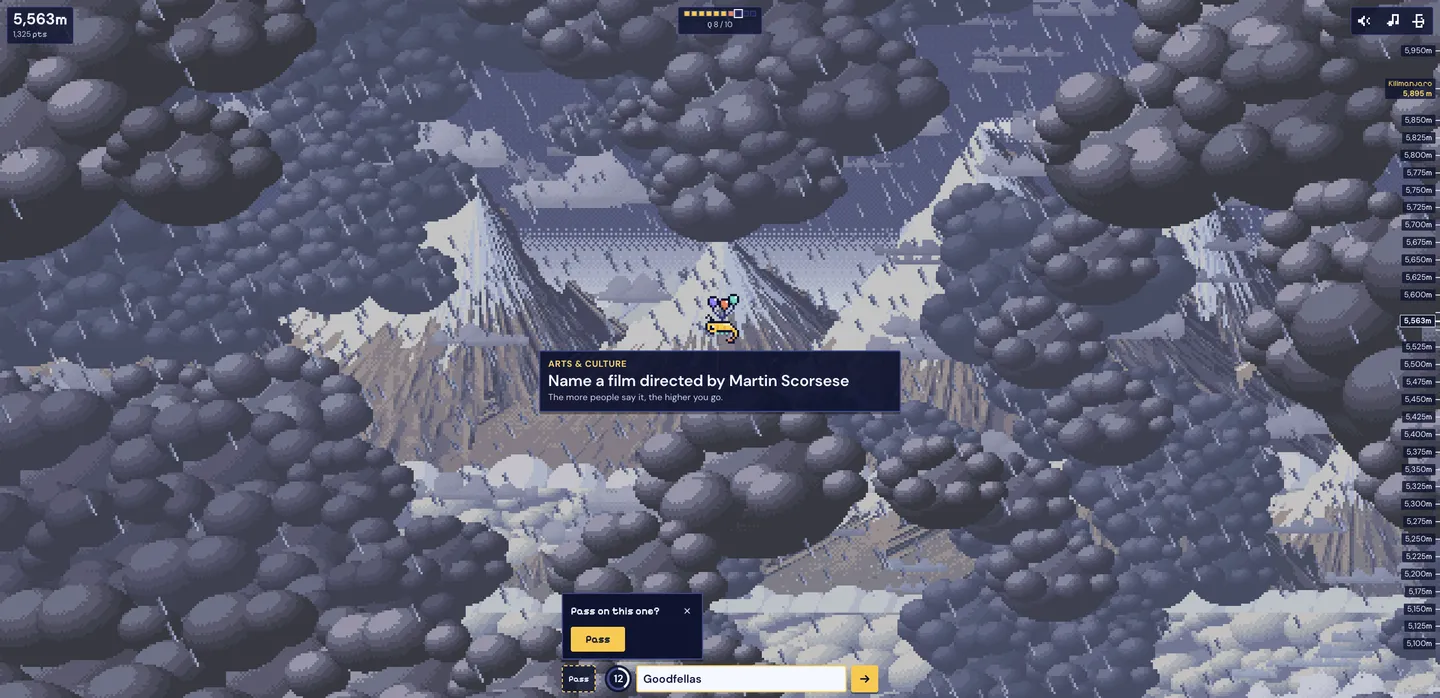
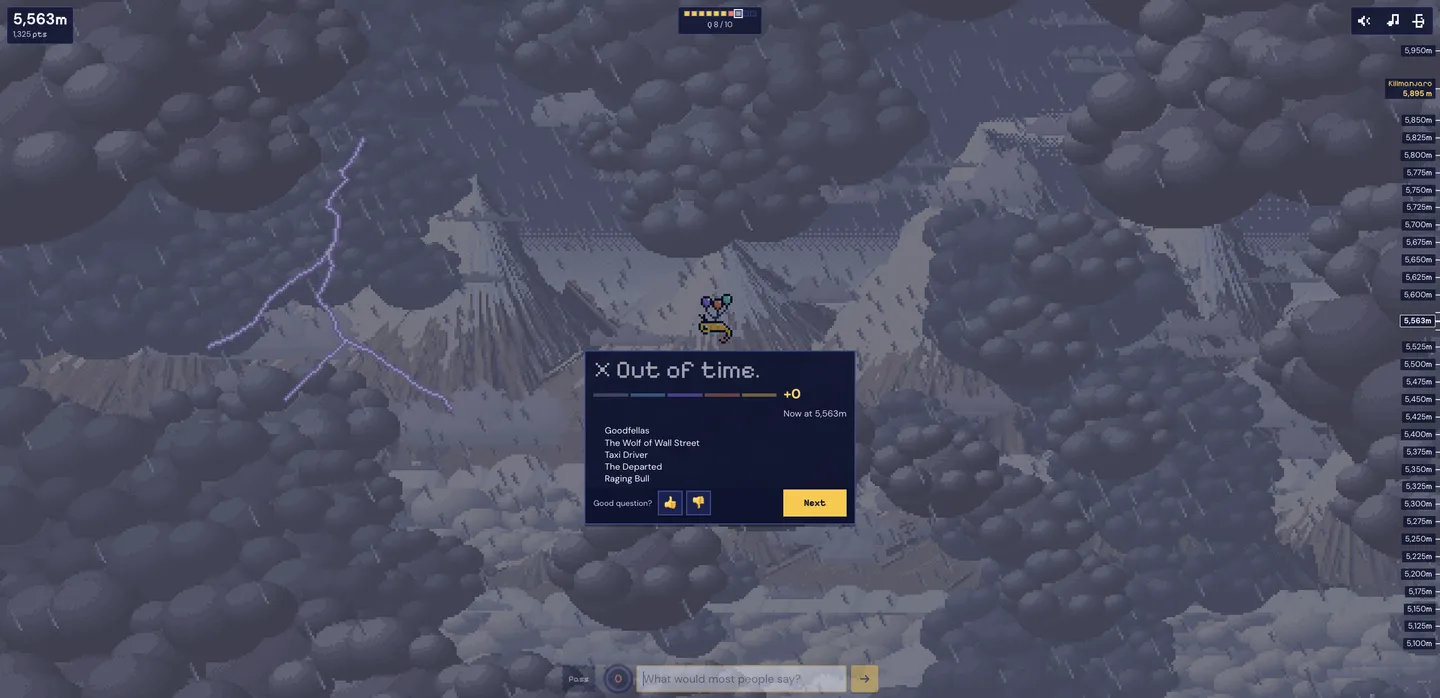
When to Pass in Noillirk, and When a Zero Costs You Nothing
Pass, an empty box and a timeout all pay zero, and none of them subtract from what you have already banked. Abandoning a prompt is therefore cheap in position and expensive in points, and the weights decide which of those two matters more.
A pass on prompt one costs a hundred points at most. A pass on prompt ten costs four hundred. The arithmetic says abandon early if nothing comes, and submit something, anything, late: an unranked answer at the heaviest weight still pays 40, which is forty times a zero.
The timeout behaves the same way with worse manners. The clock runs down, the prompt pays nothing, and the climb stays put, which is what the second screenshot above shows: an out-of-time card on a run that had already reached 5,563 metres and had not moved a metre in either direction.
I would treat prompts nine and ten as the two you never pass. If nothing comes to mind, type the most famous name in the category and take an unranked answer over a blank one.
Noillirk Daily vs Unlimited: One Shot Against a Practice Room
The Daily is the test. Ten prompts, same for everyone that day, one attempt, a streak that only moves when you finish, and a percentile against the other players who finished before or after you. Miss a day and the streak restarts from one.
Unlimited is the practice room. You pick ten prompts, twenty, or an endless run, all drawn from a bank of two hundred. Every run opens with ten questions sorted from easy to hard, meaning easy is a prompt where most people's first answer is also the board's first answer, and hard is a prompt where the crowd splits. Runs of ten and twenty can be replayed in the same order and turned into a challenge link, and the audience refills whenever the table runs short.
The reveal is where the practice actually pays. Every prompt shows the board's top five, which is the only place you can learn what the crowd says without spending a Daily on it. Twenty minutes there teaches more about the board than a month of Dailies, because a Daily shows you ten boards once and then locks until tomorrow.
The streak counter is the part I would ignore for the first week. It rewards showing up, which is not the skill here.
Two Games Called Noillirk, and Which One This Page Means
There is a second game with this name on playdaily.org, and it is not the same game. That one gives fifteen seconds per prompt and scores by how high a balloon climbs. A Daily Games press release from 12 October 2026 already listed the name as part of its platform, three days before noillirk.com opened, so the two have been confused from the start.
The terms on noillirk.com say the game is independent and not affiliated with Daily Games or any other site. Both statements hold at once: two different games share a name, and the one on this page is the version with ten prompts, thirty seconds, a hundred spectators and a board of estimates.
If a friend sends you a link where the score is measured in metres climbed on a balloon, you are looking at the other one. The rest of this page is about the crowd game.
Games Like Noillirk for Players Who Like Being Second-Guessed
The rest of this site is built on short rounds and fast decisions, and a few of those games ask for the same read of another person's mind. They are listed below.


Noillirk FAQ: Scoring, Passing and the Daily Reset
Is Noillirk free?
Yes. There is no account, no paid tier and no purchase anywhere in the game. Unlimited practice is free as well and uses the same scoring.
Do I need to download or sign up for Noillirk?
Neither. It runs from noillirk.com in a browser and keeps your progress in local storage. Switch browsers, open a private window or clear site data and the streak starts over.
How long does a Noillirk Daily take?
Ten prompts with thirty seconds each, plus a few seconds of reveal per prompt, so a full run sits around five minutes. Answering quickly makes it shorter.
How is Noillirk scored?
By where your answer sits on the board: 100 points for the top answer, 75 for second and third, 50 for fourth and fifth, 25 for sixth to tenth, and 10 for anything accepted but unranked. Each prompt has a multiplier, rising from one to four, and every 25 points pulls one of a hundred spectators.
Why was my answer rejected?
Each prompt has a prepared list of accepted answers that is longer than the board but never complete. Case, accents, leading articles and plurals are forgiven, and answers of five characters or more get one typo. A rejection costs time only, and the result card offers a way to report an answer that should have counted.
What is the difference between Daily and Unlimited?
The Daily is ten shared prompts once a day, counted toward the streak and scored against other players. Unlimited gives you ten, twenty or endless prompts from the same bank whenever you like, does not touch the streak, and shows the board's top five after every prompt.
Is the Noillirk on this page the same as the one on playdaily?
No. The playdaily version runs fifteen-second prompts and scores by height climbed. This page covers the noillirk.com version: thirty seconds per prompt, a hundred spectators and five scoring bands.
Can I play Noillirk on a phone?
Yes. The answer box is built to stay above the on-screen keyboard and the Go key submits. Touchscreen behaviour was not measured for this page beyond the developer's own description.